- 积分
- 1341
- 魅力
- 115
- 金币
- 73
- 注册时间
- 2006-8-25
|

楼主 |
发表于 2024-8-22 11:26:28
|
显示全部楼层
感谢广西师范大学外国语学院组织的翻译工作 【英文】
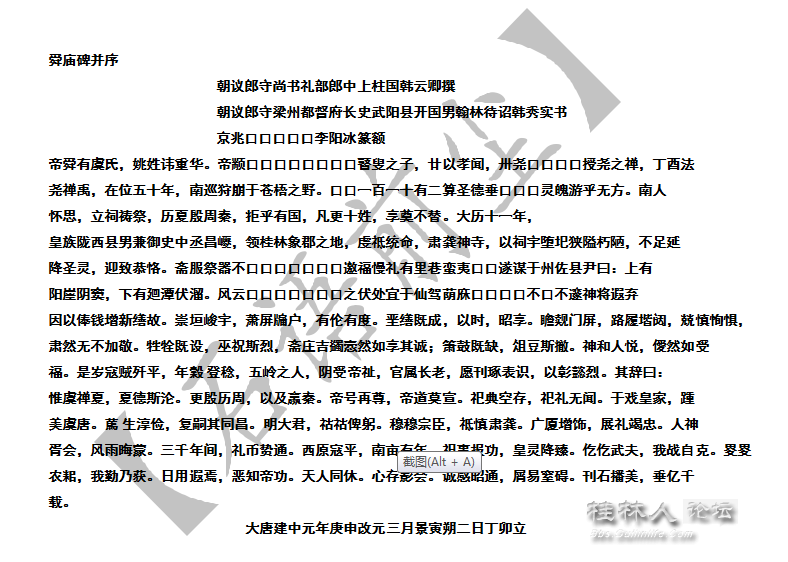
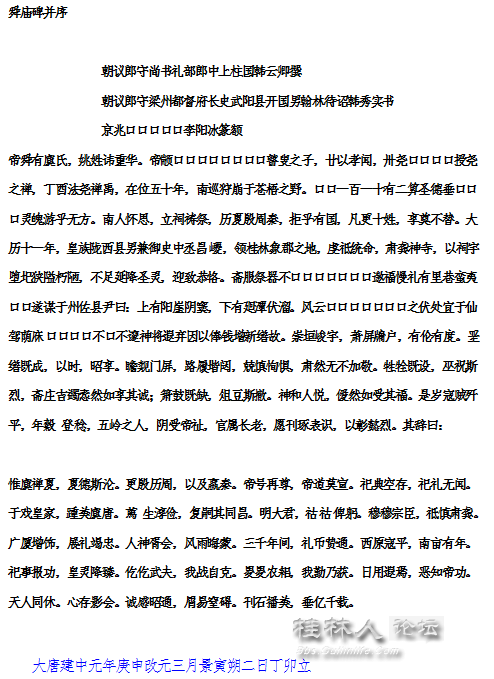
The Stone Tablet of The Shun Temple Inscribed by Han Yunqing During the
Tang Dynasty
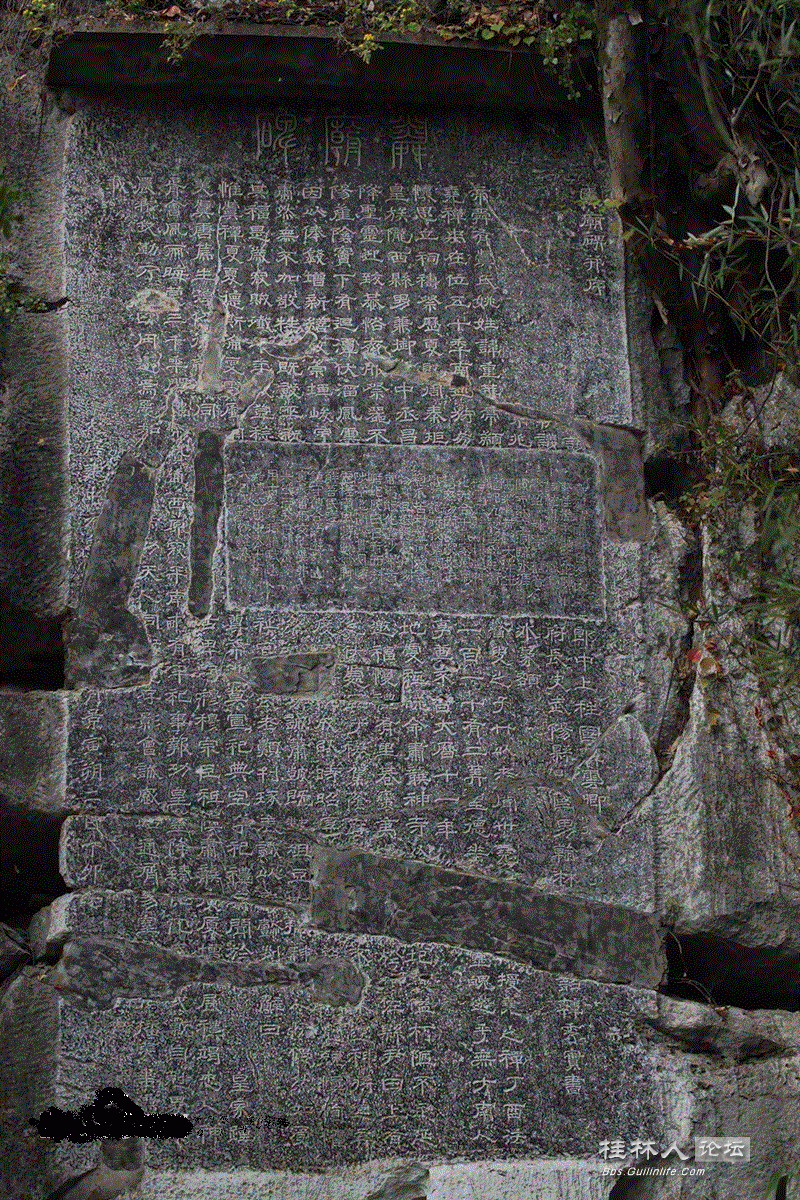
The Stone Stele of the Shun Temple stands 4.0 meters high by 2.0 meters wide. In
the first year of Jianzhong Period of the Tang Dynasty (780 C.E.), when he donated
funds to renovate the dilapidated Shun Temple (then located on the west bank of
the Li River north of Guilin city), Li Changnao, the prefectural governor of Gui
Prefecture had the stele, which recorded the process of the renovation of the temple,
engraved on the southwest cliff of the Yushan Mountain. The inscription of the
stele was written by Han Yunqing, who went on his way in the internal court by his
unique diction, and inscribed by Han Xiushi, the son of Han Zemu, a renowned
lishu (official script) calligrapher. Meanwhile, the seal characters at the top of the
tablet were inscribed by Li Yangbing, the most famous seal character master after
the Qin Dynasty and the Han Dynasty. Therefore, it is called “the Stele of Triple
Uniqueness”. And it was ever acknowledged by Qian Daxin, a scholar of the Qing
Dynasty, as “the best stone carving in Western Guangdong Province”. It is also the
earliest stele recording the renovation process of a relic existing in Guilin so far.
Unfortunately, in the fourth year of Jiajing Period of the Ming Dynasty, the middle
section of the stele was damaged by Yang Quan, the Provincial commissioner of
Guangxi and Guangdong, when he carved a poem on it.
“Lingling” Located in the Territory of the Present Guilin,
According to the Earliest Record in Ancient Classic Works
Yu Shun, one of the Five Legendary Ancient Emperor, is regarded as the forefather
of Chinese moral culture (According to Shi Ji (Historical Record), Biographic Sketches
of the Five Lords, “All the virtues of the world began with Emperor Yu.”). At the
age of 100, Yu Shun died on the way of his south expedition tour in an effort to
suppress the rebellious Sanmiao Tribe, which had defected to the southwestern
area. (This story was recorded in The Huainanzi· Xiuwu Cultivating Effort). The “Yu
Shan” Mountain and "Shun Temple" in Guilin were named and built by the ancients
in memory of Yu Shun's visit there during his south expedition tour.
In Shi Ji (Historical Record), Biographic Sketches of the Five Lords, "accomplished
in 91 B.C., the 2nd year of Zhenghe Period of the Han Dynasty, it is recorded that
Yu Shun “died in the wild of Cangwu Prefecture on his south expedition tour and
was buried in the Jiuyi Mountain of Jiangnan area, which is located in Lingling
county.” In The Classic of Mountains and Rivers·The Classic of the Four Seas, both
accomplished between 221 B.C. (the early years of the Qin Dynasty) and the early
years of the Han Dynasty, it is recorded that, “The Jiuyi Mountain up among the
mountains and waters in Cangwu Prefecture, is located in Lingling County, where
Shun was buried.”
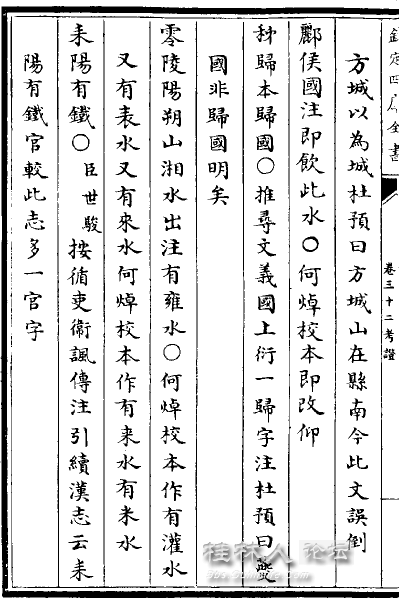
“Lingling of Changsha Prefecture” recorded in Shi Ji and the Classic of Mountains
and Rivers, was the county of Changsha Prefecture established by Emperor Qin
Shi Huang who introduced the system of prefectures and counties in 221 B.C. (the
26th year under his reign). The seat of the local government of the county whose
jurisdiction only covered the area of the present Quanzhou County, Xing’an County
and Guanyang County of Guilin City, was located at the present Xianshui Village,
Quanzhou County of Guilin City,
According to some ancient works, “the Jiuyi Mountain” referred to the mountain
range of the southern borderline of “the Changsha Kingdom” at least as early as
202 B.C., (i.e. the fifth year of the Han Dynasty) since the area under the Changsha
Kingdom’s jurisdiction was that under Changsha Prefecture’s jurisdiction handed
down from the Qing Dynasty to the West Han Dynasty. Located to the south of the
Han Jiang River, the southern territory of the area was that of the present Xintian
County of Hunan Province to the east, Quanzhou County and Guanyang County
of Guangxi Province to the west. To be specific, it was the uninterrupted extension
of the border of the Jiuyi Mountain to the direction of the east, the south and the
west. (In Hanshu The History of the Han Dynast·Memorial to Dukes and Princes, it is
recorded that, “The area of the southern territory of the Han Jiang River, where the
Jiuyi Mountain extends uninterrupted, is where Changsha Prefecture is located.”). So,
that is to say, the Jiuyi Mountain should have been a mountain range extending 200
to 300 km from the present mountain range of Guanyang County and Quanzhou
County to the eastern mountain range of Xintian County.
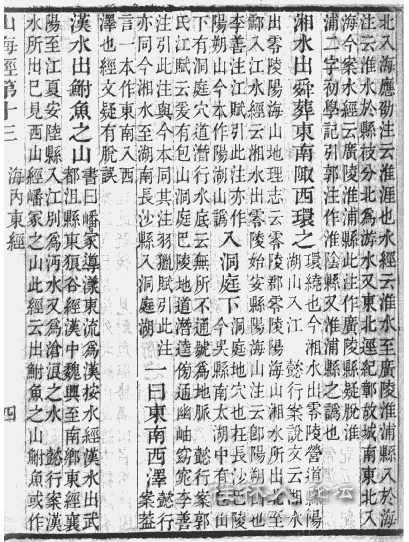
According to the ancient works, “the burial site of Shun” is the in the Northwestern
part of the Ocean Mountain (located in the present North of Guilin City, called the
Yanghai Mountain in ancient times), the source of the Xiangjiang River. (In The
Classic of Mountains and Rivers·The Eastern Classic of Rivers, it is recorded that,
“The southeastern corner of the source of the Xiangjiang River was where Shun
was buried while the river surrounded the west of the burial site.”). In the History
of the Han Dynasty·Records of Geography, and Notes on Book of Waterways, it is
respectively noted that the source of the Xiangjiang River recorded is the Yanghai
Mountain (“Lingling the Yanghai Mountain, the source of the Xiangjiang River”, “the
Xiangjiang River originates from the Yanghai Mountain of Lingling, Shi’an County”).
It has long been impossible to do textual research of the specific burial site of
Shun for it had been a basic burial custom not to pile up mud nor to plant trees and
set up tablets as memorial marks prior to the Warring States Period. There were not
any marks, not to mention any concrete constructions to indicate the specific sites
of tombs. Therefore, quite a few “Shun Mausoleums” have been built for people to
visit and pay homage to in the county.
|
|


 狗仔卡
狗仔卡
 发表于 2017-11-15 01:24:31







 提升卡
提升卡 置顶卡
置顶卡 沉默卡
沉默卡 喧嚣卡
喧嚣卡 变色卡
变色卡 显身卡
显身卡